
Free printable
Visual schedule: a free printable daily template
A free printable visual schedule for children aged 3 to 6: twelve picture cards to cut out and put in order, and how to use them. Nothing to sign up for.
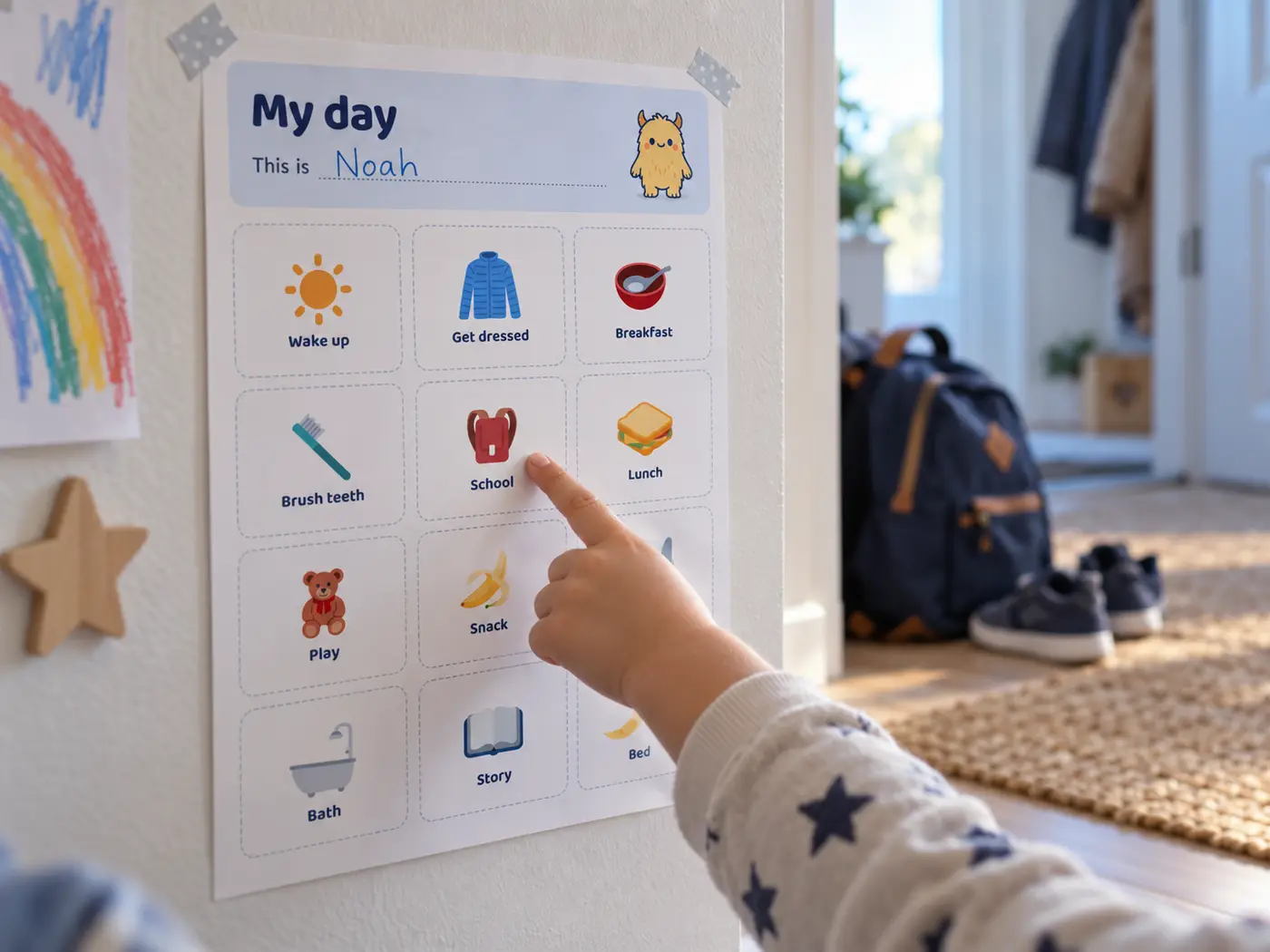
My day
This is

 Wake up
 Get dressed
 Breakfast
 Brush teeth
 School
 Lunch
Lunch Play
Play Snack
Snack Dinner
 Bath
Bath Story
Story Bed
BedPut it up as it is, or cut the cards out so the order can change.
dozumo.comWant it different?
Change the steps, the pictures and who is on it, then print your own. Nothing to sign up for.
How to use it
Print it and put it up at your child's eye level rather than yours. A schedule read from below, on tiptoe, gets read once. Left as one sheet it is already the day in order, which is enough for a lot of families and needs no scissors.
Cut them out when one of two things is true. Your days are not the same, so the order has to change. Or you want the card to come off as each thing is done, which is the part a whole sheet cannot do: a child who removes breakfast and sees four cards left has answered “how much longer” without asking anybody.
Make it your day, not this one
Twelve cards, and they are landmarks rather than instructions: the points a young child uses to work out where they are. Use the ones that are your day and put the rest in a drawer. Nursery instead of school, Grandma on a Thursday, swimming. Blank card and a pen for anything missing.
Put five or six on the strip at a time, not all twelve. A schedule with every small thing on it stops being scannable from across a kitchen, which is the one job it has. If a particular moment is where the day falls apart, that moment wants a chart of its own rather than another card on this one.
Some families use this for one routine rather than the whole day, and it works the same way. Potty training is the common one, where the cards are the trip rather than the day, and the child is checking the sequence instead of the clock. Laminating them, or sticking them to card, is what makes a set last more than a fortnight.
Why visual schedules work
Because they move the sequence out of a child's head and onto a wall. A four-year-old asked to get ready is holding four or five instructions at once, in an order they didn't choose, while being hurried. The same child looking at a row of pictures is doing one thing and can see what follows it.
This is not a niche technique. Visual supports are standard practice in early years classrooms and in occupational therapy, they are among the better-evidenced supports for young children, and they are used with plenty of children who have no diagnosis of anything. Every routine chart you have seen is a visual schedule with the days added.
When a whole day is too much: first and then
For a child not ready for a whole day, or on a morning that has already gone wrong, put two cards up and no more: what is happening now, and what happens straight after. First shoes, then park. First teeth, then story.
It's the same idea with the horizon pulled in, and often the version that works under three. The point is that the child can see the good thing coming, which is what makes the dull thing in front of it survivable.
If your child is autistic or has ADHD
This sheet will work, and there's more to say than fits here. Choosing between photographs, drawings and words, teaching a child to use a schedule rather than assuming they will, and moving to something portable are all decisions that matter more when a schedule is doing real work rather than smoothing a morning. Visual schedules for autism: how to build one at home covers all three.
Or let Dozumo do it
A set of cards has one thing it can't do, which is tell a child the step is finished at the moment they finish it. It waits to be moved, and on the mornings that need it most nobody has a hand free.
Dozumo is the same day with a creature working through it alongside your child. It reacts as each thing is done and celebrates the last one. It also holds the order, so nobody has to remember where everyone had got to, and it reorders itself for a Tuesday without anybody finding the scissors. Your child picks the creature; the one on this sheet is Mozumo.
Nothing is ever taken away, and there's no version of the day that counts as failed. Join the waitlist and we'll tell you when it opens.
Common questions
What is a visual schedule?
A row or column of pictures showing what happens, in the order it happens. It replaces a spoken list a young child cannot hold, so instead of remembering four instructions they look at where they are and do the next picture. Home versions cover a day or a routine; classroom ones cover a session. This one is a day, as twelve cards to cut out and arrange.
How do you make a visual schedule?
Pick the six or so points your child uses to tell where they are in the day and give each one a picture, on a card of its own rather than a list. Photographs of your own house work as well as drawings and are better for some children. Hang the strip at their height, put today's cards on it in order, and take each off as it is done. The set on this page is free if you would rather not draw it.
What age is a visual schedule for?
Three to six is the range this one is drawn for, and preschool is where it earns its keep, because a child of that age can follow a sequence but cannot yet hold one. Under three, two cards work better than twelve. Older children usually move on to a written list, though plenty of autistic and ADHD children keep using pictures for years and there is no reason to hurry that.
Do visual schedules only work for autistic children?
No. They are strongly associated with autism because they are standard practice there and the evidence base was built there, but the thing they fix is ordinary: a young child cannot hold a sequence of instructions while being hurried. Reception classrooms use them for every child in the room. If mornings in your house are chaos, this will help whether or not anyone has a diagnosis.
What is a first-then board?
A visual schedule cut down to two cards: what is happening now, and what happens straight after. First shoes, then park. It is the version that works under three, and the one to fall back on when a whole day is more than a child can look at. Two cards from this sheet make one.