
Free printable
Free printable bedtime routine chart
A free printable bedtime routine chart for toddlers and children aged 3 to 6. Five simple steps, a week of stickers, and nothing to sign up for.
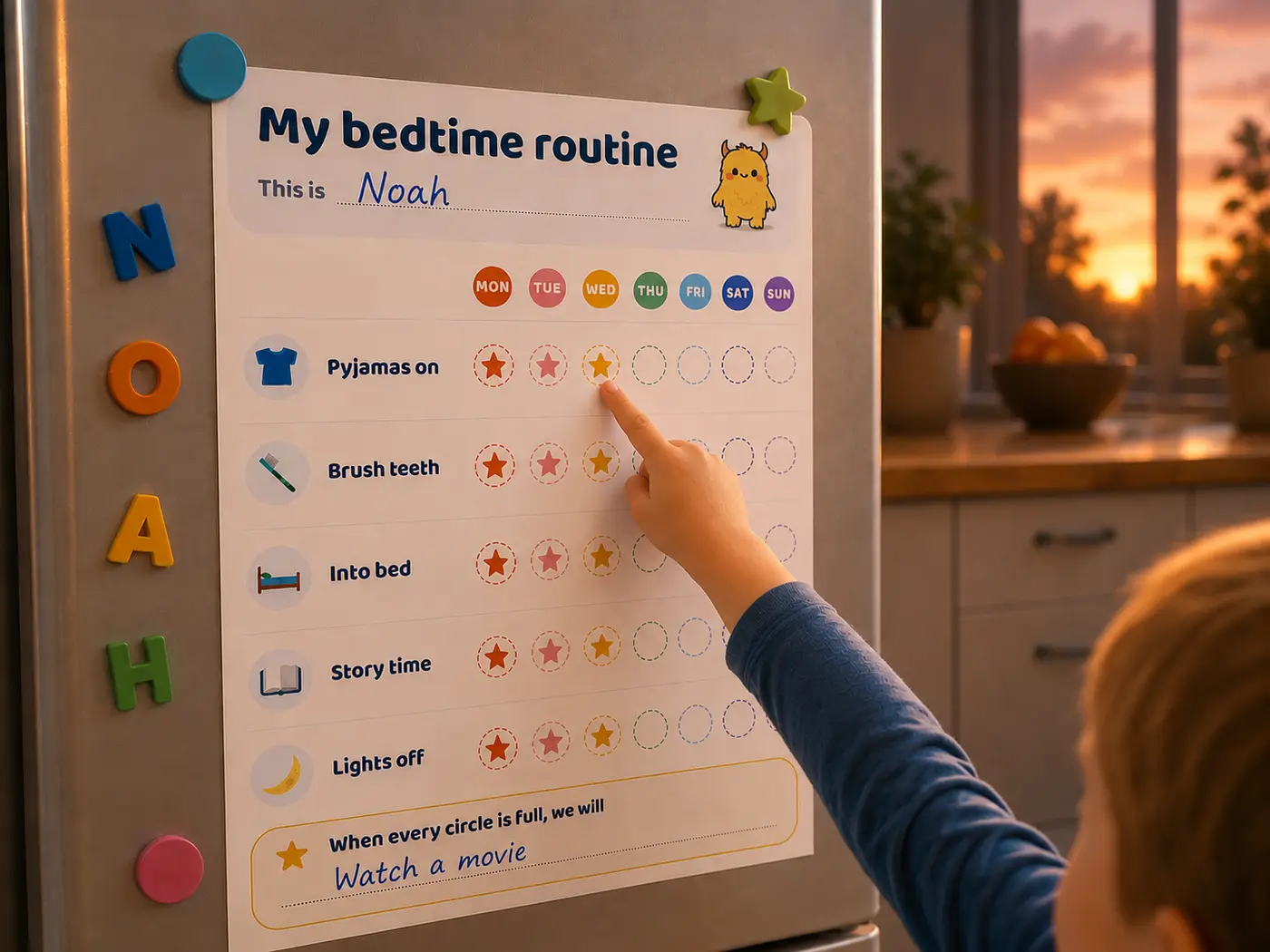
My bedtime routine
This is

 Pyjamas on
 Brush teeth
 Into bed
 Story time
 Lights off
Want it different?
Change the steps, the pictures and who is on it, then print your own. Nothing to sign up for.
How to use it
Print it, write your child's name at the top, and put it somewhere they can reach. The fridge door is the classic for a reason. Each evening they mark off the steps they did. Stickers work better than ticks for under-fives, because putting the sticker on is itself the reward.
Five steps is the most a young child can hold, which is why this one is drawn for three to six year olds. If bedtime in your house has more than five, put the five that cause the most friction on the chart and leave the rest off. The chart is for the hard part, not a full record of the evening.
Why a chart works at all
Two things are doing the work here, and both have names. The first is a visual schedule: breaking a routine into steps a child can see, so “get ready for bed” stops being one overwhelming instruction and becomes five small ones. Occupational therapists and reception teachers use them daily. The second is a token economy: earning something small and immediate for a specific behaviour, then trading it for something bigger later. That's what the stickers and the prize line at the bottom are.
Neither is new and neither is ours. They are simply the two techniques that work with children this age, which is why every routine chart you find is some version of the same idea.
If the novelty wears off
It will, and that's normal rather than a failure. Paper charts tend to work for two or three weeks and then fade, because the chart stops being new and nothing about it changes. When that happens, either change the reward or move to something that can change on its own.
Or let Dozumo do it
Dozumo is an app that helps children build the routines that are hardest to build: getting into bed, getting dressed, brushing teeth without a nightly negotiation.
Your child chooses their own creature to do it with; the one on this chart is called Mozumo. It's there every evening, reacting as they work down the steps and celebrating when they finish. For a three-year-old that's the whole reason to bother. It's the one thing a piece of paper cannot give them.
Finishing a step earns Zumos, which your child spends on real rewards that you set. A film night while they are small, pocket money once they are older.
It also doesn't go stale the way a chart on the fridge does. The creature grows as your child keeps developing, changing into something new they haven't seen before, and there's a chest of treasures to unlock along the way, so tomorrow evening is worth turning up for.
This chart is generated from the same five steps, in the same order. Join the waitlist and we'll tell you when the app opens.
Common questions
What should be on a bedtime routine chart?
Across the bedtime charts currently ranking, four steps are close to universal: pyjamas on, brush teeth, a story, and lights off. The fifth varies. This chart uses getting into bed, because in most houses that is where the resistance actually is. Bath is the other common choice, and it is left off here on purpose: most families do not bath every night, so it leaves four empty circles a week and breaks the reward.
Should a bedtime routine include going to the toilet?
Only if it is a problem in your house. It is not a standard step. It appears on a minority of published charts and in none of the clinical bedtime protocols, which start from bath, quiet activity and lights out within thirty minutes. Where it earns its place is with a child who uses one more wee as a stalling tactic, because a step on the chart is spent before lights off rather than after.
What age is a bedtime routine chart for?
Roughly three to six. Below three, a child cannot yet hold a sequence, and a one-step picture works better than a chart. Above six or seven, most children have the routine without a visual reminder, and the chart becomes a reward chart wearing a routine chart's clothes. This one is drawn for toddlers and preschoolers, which is why the pictures carry the meaning and the words are for the grown-up reading them out.
Do bedtime routine charts actually work?
For a few weeks, reliably. A visual bedtime routine chart is a visual schedule, and visual supports are one of the better-evidenced supports there are for young children. What fades is not the technique but the novelty: paper cannot change, so after two or three weeks the chart stops being interesting. When that happens, change the reward rather than the child.
How do I make my own bedtime chart?
Take the five steps that cause the most friction, put them in the order they actually happen, and draw or print one picture for each. Add a column per day and a line at the bottom for the reward. Stick it somewhere your child can reach without being lifted. That is the whole design, and the version on this page is free if you would rather not.