
Free printable
Free printable behavior charts
Free printable behavior charts for children aged 3 to 6. Five specific, positive behaviors, a week of stickers, and nothing to sign up for.
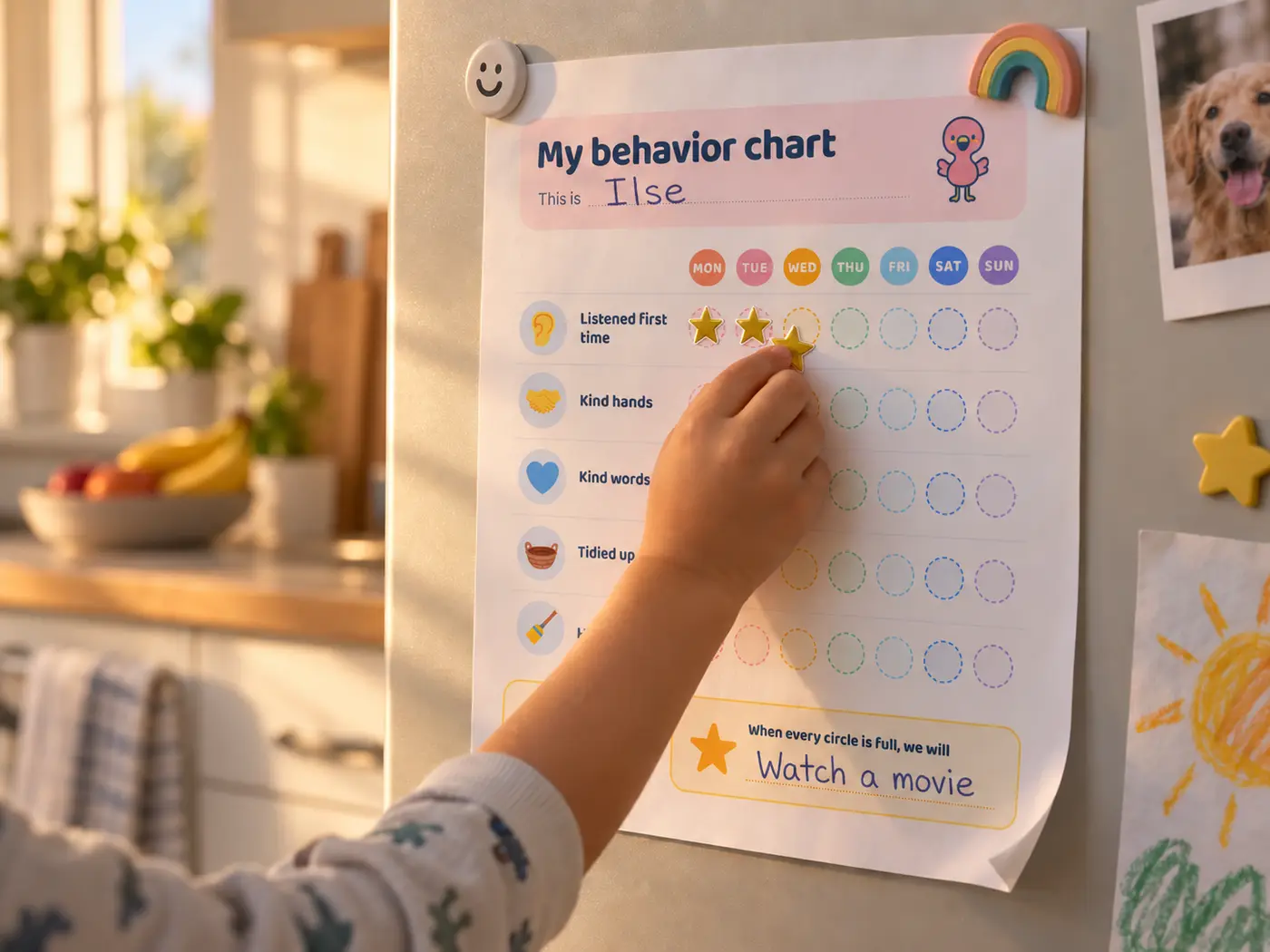
My behavior chart
This is

 Listened first time
 Kind hands
 Kind words
 Tidied up
 Helped at home
Want it different?
Change the steps, the pictures and who is on it, then print your own. Nothing to sign up for.
How to use it
Print it, write your child's name at the top, and put it somewhere they can reach without being lifted up to it. Fill it in together once a day, in the evening, rather than in the moment. A chart marked in the middle of an argument becomes part of the argument.
Mark what went well and leave the rest blank. Say nothing about the blanks: a child who had a hard Tuesday already knows. This is a record of what they managed, not a report card, and Wednesday has its own circles. Stickers work better than ticks under five, because putting the sticker on is itself the reward.
Choosing the five behaviors
This is the part that decides whether a chart works. It's also where most of them fail. “Be good” cannot be marked off, so a child can never be sure they have done it. Name the thing you actually want to see, in the words your child would use about themselves: kind hands, listened first time, tidied up.
Say what to do rather than what to stop. “No hitting” leaves a four-year-old holding a rule with no picture attached to it. “Kind hands” is the same rule written as something they can succeed at. It's also the one they can call to mind when it matters.
Three to five rows is the right number. The five on this chart are the ones that come up most often in a house with a three to six year old. If one of them isn't your problem, cross it out and write your own in the gap. A chart aimed at everything gets marked for nothing.
Do behavior charts actually work?
For a few weeks, for small specific behaviors, in a house where the adults are consistent about it. Not for changing who a child is, and not on their own.
What is doing the work is not really the sticker. It's immediate, specific attention paid to something a child did well, on the day they did it, which is a thing every parent means to do and almost nobody manages reliably at the end of a long day. The chart is a prompt for the adult at least as much as for the child. That's also why it stops working the week it stops being filled in.
The argument against behavior charts, and the part of it that is right
Search for behavior charts and you'll find people arguing against them. Some of that argument is worth listening to. Most of it is aimed at something else.
The strongest version is about clip charts: the classroom kind, where a child's name moves up and down a public scale in front of thirty other children. That's comparative, and it's punitive. A child who is on red by nine in the morning has nothing left to work towards and an audience who watched it happen.
Two objections do carry over into a house. A reward can quietly become the reason to behave well and crowd out the reason you were hoping for. And a chart can turn into a negotiation, where a child asks what they get before deciding whether to help.
Both are about how a chart is used rather than about the paper. A chart that stays inside one family, never takes a mark back off, and gets put away once the habit holds avoids most of it. Nothing on this sheet can be lost. There's no red on it, no scale to move down, no row for the things that went wrong.
When to stop using it
Two or three weeks, usually. Paper cannot change, so once the novelty has gone the chart stops being interesting and starts being wallpaper. Stop on purpose rather than letting it fade: tell your child that the thing they were working on is now just something they do, and take it down together. A dead chart left on the fridge teaches them the marks didn't matter much.
If the behavior isn't holding yet, change the reward rather than the child, or go back to three rows and pick the one that matters most.
Or let Dozumo do it
Dozumo is an app for the same job, built on the same idea and without the two problems paper has: it can't be forgotten at the end of a long day, and it doesn't go stale while a child is still looking at it.
Your child chooses a creature to do it with. The one on this chart is called Mozumo. It reacts as they work through the day and celebrates when they finish, which for a four-year-old is most of the reason to bother.
Nothing is ever taken away. There are no points to lose and no bad days recorded, which is the half of the argument against behavior charts we took seriously enough to build the app around. Finishing something earns Zumos, and your child spends those on rewards you set yourself.
Join the waitlist and we'll tell you when it opens.
Common questions
What should go on a behavior chart?
Three to five specific things your child can do, written as actions rather than rules. Kind hands, kind words, listened first time, tidied up and helped at home are the five here, and they cover most of what goes wrong between three and six. Avoid anything you cannot picture happening: “be good”, “behave” and “be nice” cannot be marked off, so they cannot be achieved either.
Do behavior charts actually work?
For a few weeks, for small specific behaviors, where the adults are consistent about filling it in. What does the work is immediate and specific attention paid to something a child did well, on the day they did it. The chart is mostly a way of making sure that happens, which is why it stops working the week it stops being filled in rather than the week the child stops caring.
Are behavior charts bad for children?
The version that deserves the criticism is the classroom clip chart, where a name moves down a public scale in front of the class. That is comparative, punitive, and stays in a child's memory in a way a sticker does not. At home the real risks are smaller: a reward becoming the only reason to behave well, and a child learning to negotiate. A chart that is private, never takes a mark back, and is retired once the habit holds avoids most of it.
What age is a behavior chart for?
Roughly three to six, which is why this one is drawn with pictures. Below three a child cannot connect this morning to a sticker put on in the evening, and immediate praise works better than any chart. From about seven the chart stops being interesting on its own, and the conversation is more use than the sheet.
How many behaviors should I track at once?
Three to five. One is hard to build a week around, and more than five means no single row gets attention on a busy day, so the chart quietly becomes a list of things your child is failing at. If you are not sure, start with three and add one when those three are holding.