
Free printable
Free printable tooth brushing chart
A free printable tooth brushing chart for children aged 3 to 6. Morning, night, two minutes and the step most charts leave off, with nothing to sign up for.
My tooth brushing chart
This is

 Morning brush
 Night brush
 Two whole minutes
 Spit, no rinse
Want it different?
Change the steps, the pictures and who is on it, then print your own. Nothing to sign up for.
How to use it
Print it and tape it to the bathroom wall at your child's height, next to the mirror rather than behind them. Mark it straight after each brush. There are two brushing rows because there are two brushes. A child who does the morning one and not the night one should be able to see exactly that.
The other two rows are about how rather than whether. Those are the ones worth keeping once the twice-a-day habit holds.
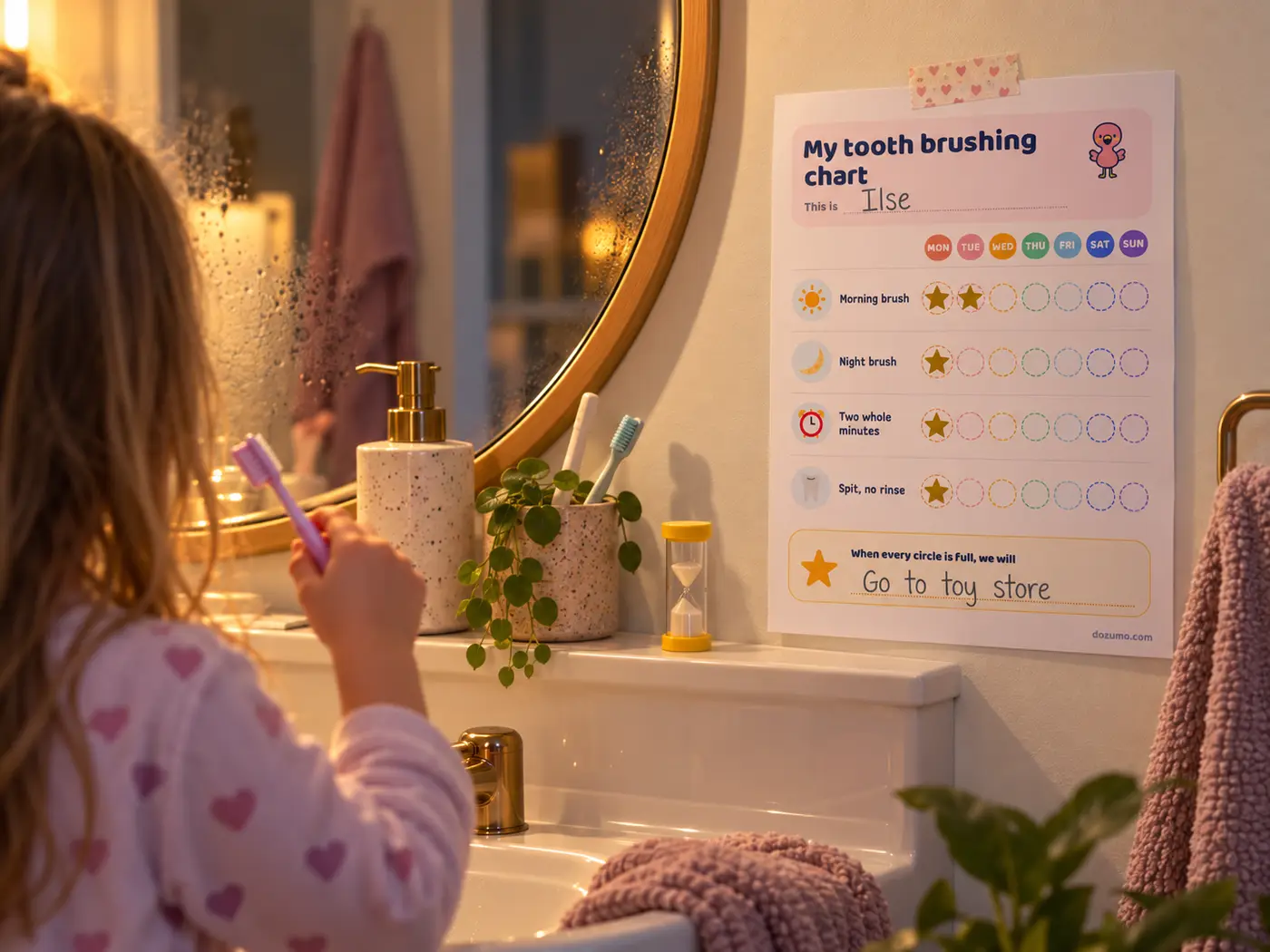
The row most charts leave off
Spit, do not rinse. After brushing, a child should spit the toothpaste out and stop there, because rinsing with water washes away the fluoride that was the point of the toothpaste. It's standard dental advice, it takes ten seconds to teach, and it appears on almost none of the charts you'll find.
Two whole minutes is the other one. Almost nobody brushes for two minutes without something counting: a timer, a sand egg-timer, a song your child picks. The row is on the chart because it's the part that quietly doesn't happen, not because a child cannot manage it.
Your dentist is the right person for anything specific to your child, including how much toothpaste and when to stop brushing for them.
If your child hates having their teeth brushed
A chart won't fix this on its own, and it's worth saying so. What tends to help is taking the surprise out of it: same place, same order, same song, and a child who can see on the wall that this is the third of four things rather than an ambush.
Letting them go first and finishing off yourself is the usual compromise. It's roughly the developmental path anyway. On a bad night, the brush going in at all is a win worth marking.
When they can do it alone
Later than most children would like. Young children don't have the fine motor control to clean their own teeth properly. The usual advice is that an adult keeps brushing, or finishing off, until around seven. The chart is useful in the meantime because it makes the child a participant rather than a patient, which is most of what makes the next few years bearable.
Or let Dozumo do it
The two minutes is the part an app is genuinely better at. Dozumo runs the same routine with a creature counting alongside your child, so the timer is something they are doing with someone rather than something being done to them. The one on this chart is Mozumo.
Nothing is ever taken away, including on the nights it doesn't happen. Join the waitlist and we'll tell you when it opens.
Common questions
How long should a child brush their teeth?
Two minutes, twice a day, which is the same advice as for adults and much harder to achieve. Use something that counts so nobody is guessing: a timer, a sand egg-timer, or a song your child chose themselves. Two minutes without a timer is almost always closer to forty seconds.
Should children rinse their mouth after brushing?
No. Spitting the toothpaste out and stopping there leaves the fluoride on the teeth, and rinsing with water washes it off. It is standard dental advice and it is the row on this chart that you will not find on most others. Ask your dentist about anything specific to your child.
At what age can a child brush their own teeth?
They can hold the brush much earlier than they can clean their teeth properly. The usual advice is that an adult brushes or finishes off until around seven, because the fine motor control is not there before that. Letting a child go first and finishing off yourself is the compromise that keeps everybody sane.
Does a tooth brushing chart help?
With consistency, yes, for a few weeks. What it mostly fixes is the night brush, which is the one that gets skipped when everyone is tired and nobody is keeping count. Seeing four marks in the morning row and one in the night row is more persuasive than an argument about it.
What should be on a tooth brushing chart?
The two brushes at a minimum, kept as separate rows so you can see which one is being missed. Two whole minutes and spitting without rinsing are the two worth adding, because they are the parts that quietly do not happen. Anything more and a bathroom wall chart stops being readable by the person it is for.