
Free printable
Free printable morning routine chart
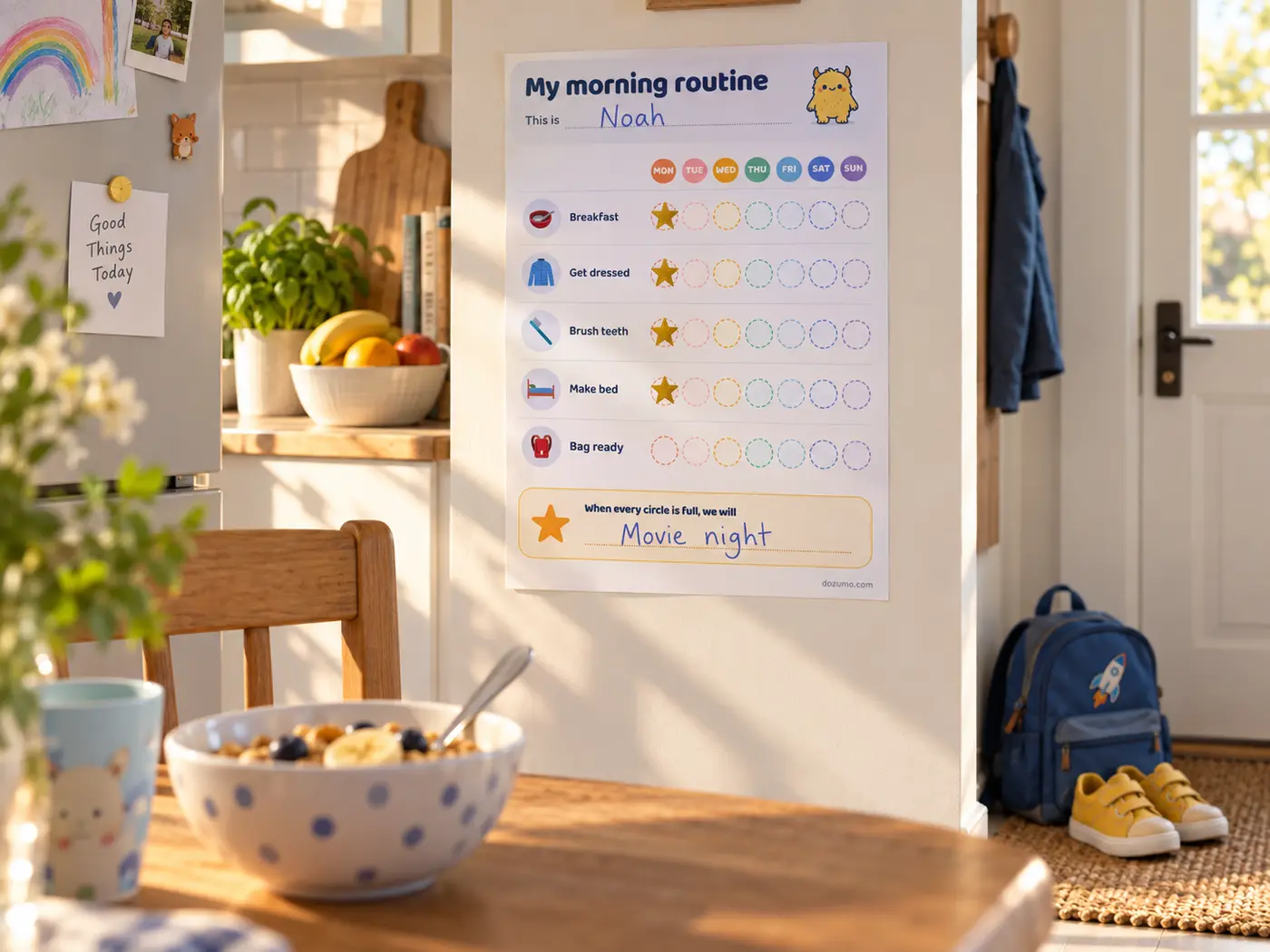
A free printable morning routine chart for children aged 3 to 6. Five steps to get out of the door, a week of stickers, and nothing to sign up for.
My morning routine
This is

 Breakfast
 Get dressed
 Brush teeth
 Make bed
 Bag ready
Want it different?
Change the steps, the pictures and who is on it, then print your own. Nothing to sign up for.
How to use it
Print it and put it where the morning actually happens, which is usually the kitchen rather than the bedroom. Mark each step as it's done rather than at the end, because the end of a school morning is the front door and nobody is stopping there to fill in a chart.
The order on the sheet is one that works in a lot of houses, not the only one. If your child eats breakfast in their pyjamas and gets dressed afterwards, swap the top two rows. If nobody makes a bed on a Tuesday, cross it out. It's your chart once it's printed. A chart that describes somebody else's morning gets ignored by Wednesday.
Why mornings are harder than bedtimes
The same child, the same number of steps, and a much worse hit rate. It's worth knowing why, because it stops you concluding the chart doesn't work.
A bedtime routine has no deadline. A morning has one, it belongs to you rather than to your child, and they have no reason to feel it. On top of that they have been awake for ten minutes and are being asked to do five things in sequence, which is the hardest thing you will ask of them all day. The chart helps because it moves the nagging onto paper. Instead of you naming the next step, they look.
The other half isn't on the chart: as much as possible of the morning done the night before. Clothes out, bag packed, shoes by the door. Every step you can move to a time when nobody is in a hurry is a step that cannot go wrong at eight in the morning.
Five steps, and the one to drop first
Five is the most a three to six year old holds. If the mornings are still chaos, take one off rather than adding a reward. Making the bed is the usual candidate: it's the step with the least consequence attached and the one most likely to be the adult's preference rather than the child's problem. A four-step chart that gets finished beats a five-step chart that never does.
If it stops working
Two or three weeks is normal, and then paper stops being interesting because nothing about it changes. Change the reward before you change the chart, and shorten the target from a week to a day if the week is too far away to feel real. If mornings are still hard after that, the problem is usually bedtime rather than breakfast.
Or let Dozumo do it
Dozumo runs the same five steps on a phone, with a creature working through them alongside your child. The one on this chart is Mozumo. It reacts as each step is done and celebrates the last one, so the thing pulling them along is not you saying “shoes” for the fourth time.
It also doesn't need marking. On a school morning that's most of the point. Join the waitlist and we'll tell you when it opens.
Common questions
What should be on a morning routine chart?
The steps that actually cause the argument in your house, and no more than five. Breakfast, getting dressed, teeth, bed made and bag ready are the five here. Leave off anything that happens without a fight, because a chart is for the hard part rather than a record of the morning.
What age is a morning routine chart for?
Three to six. Below three, five steps in sequence is beyond what a child can hold and two works better. From about seven most children have the routine and the chart turns into a reward chart, which is a different thing wanting a different sheet.
Do morning routine charts work?
For a few weeks, and they work by moving the reminding off you and onto the wall. Your child looks at the chart for the next step instead of waiting to be told, which is a smaller change than it sounds and takes most of the heat out of the room. What a chart cannot do is create time, so if the morning is genuinely too short it will not help.
How do I stop nagging in the morning?
Give your child something other than your voice to check. That is the entire mechanism of a routine chart. Point at the sheet rather than naming the step, and let them tell you what is next. It takes a week or two before they do it without prompting, and the prompt in the meantime should be “what does your chart say” rather than the answer.
Should getting dressed come before or after breakfast?
Whichever loses you fewer minutes. Dressed first avoids the change of clothes after a spilt bowl and means a child who dawdles over toast is at least dressed while they do it. Breakfast first suits a child who wakes hungry and cannot do anything until they have eaten. There is no right answer, so put the rows in your order and swap them if the first week says otherwise.