
Free printable
Free printable potty chart
A free printable potty training chart for toddlers. Four steps a child can actually control, a week of stickers, and nothing to sign up for.
My potty chart
This is

 Told a grown-up
 Sat on the potty
 Washed hands
 Dry pants
Want it different?
Change the steps, the pictures and who is on it, then print your own. Nothing to sign up for.
How to use it
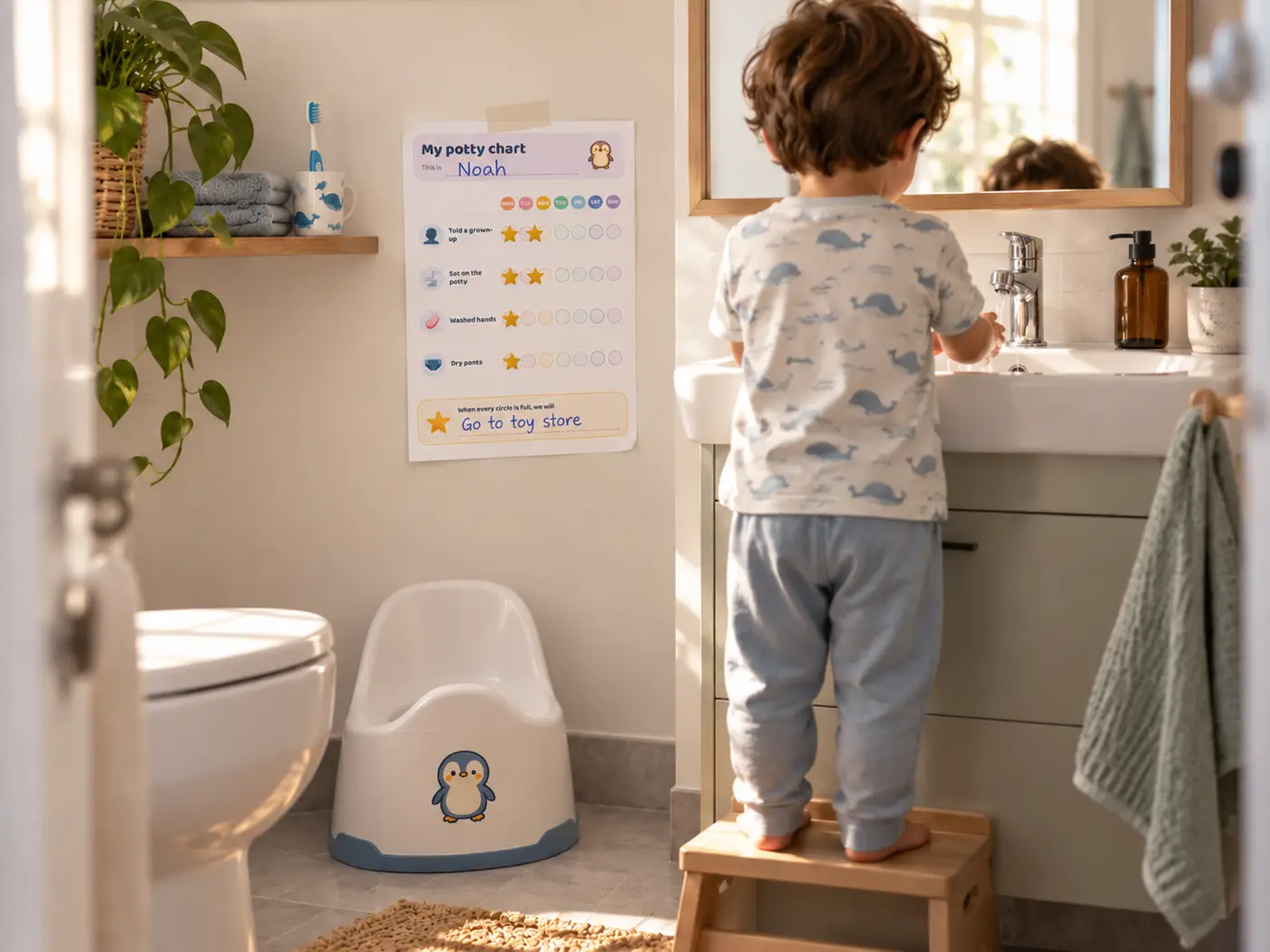
Print it and put it in the bathroom, at your child's height, where the thing it's about actually happens. Mark it straight afterwards rather than at the end of the day. At two and three the gap between doing something and being noticed for it has to be almost nothing, or the sticker is about the sticker.
Four rows, marked separately. A child who told you they needed to go, sat down, and then produced nothing has done three of the four, and they get three marks. That's the whole design of this sheet, and the reason it has four rows instead of one.
Why it does not have a row for doing a wee
Almost every potty chart you will find records the result: a sticker for a wee in the potty, nothing otherwise. It's the obvious design. It also puts a two-year-old in the position of being marked on something they don't yet reliably control.
The parts they do control are saying so, getting there, sitting down, and washing afterwards. Those are learnable, they are the actual sequence, and a child can succeed at all of them on a day when the outcome doesn't arrive. Dry pants is on there as the fourth row because it matters to you and they can feel it, but it's one row of four rather than the only thing on the sheet.
If the outcome is what motivates your child, add it. There's room, and it's your chart once it's printed.
When to start
Most children are ready somewhere between about two and three, but the age is the least useful signal. The ones worth watching are whether they stay dry for an hour or two at a stretch, whether they can pull their own pants down, whether they tell you about a nappy after the fact, and whether they show any interest in the toilet at all.
Starting before those are in place mostly produces a longer process and a worse mood on both sides. There's no prize for early. If you're worried about how it's going, or about anything physical, a health visitor or your doctor is the right person to ask rather than a chart.
Accidents
There's nothing on this sheet to record an accident with, and that's deliberate. Nothing is taken back off, no square is crossed out, and a bad day leaves blanks rather than marks against a child.
Accidents are part of learning this rather than evidence it's failing. The useful response is a change of clothes and as little conversation as you can manage, then the next trip marked as normal. A chart that reacts to accidents teaches a child that the bathroom is where they get in trouble, which is the opposite of what you want them to feel about it.
If it stops working, or goes backwards
Both are common. Charts fade after two or three weeks because paper cannot change, and potty training itself goes backwards around new babies, house moves, illness and starting nursery. Neither means the approach was wrong.
When the chart goes stale, change the reward before you change anything else, or shorten the target from a week to a day. When the training goes backwards, the usual answer is to take the pressure off for a fortnight and start again, rather than to push. If it keeps going backwards, that's worth a conversation with your doctor.
Or let Dozumo do it
The hardest part of a potty chart is that it needs marking at the exact moment nobody has a free hand. It lives in the bathroom, it gets forgotten, and by bedtime nobody can remember what happened at eleven in the morning.
Dozumo runs the same four steps on a phone that is already in the room, and your child marks them off themselves with a creature reacting alongside them. The one on this sheet is Mozumo.
Nothing is ever taken away. There is no way to record a bad day and nothing to lose, which matters more here than anywhere else we build for. Join the waitlist and we'll tell you when it opens.
Common questions
What age should you start potty training?
Usually somewhere between two and three, but readiness is a better guide than age. Look for staying dry an hour or two at a time, being able to pull their own pants down, telling you about a wet nappy afterwards, and any interest in the toilet. Starting before those are there tends to make the whole thing take longer. Ask a health visitor or your doctor if you are unsure.
Do potty training charts work?
They help with the parts of it that are learnable, for a few weeks. A chart makes the sequence visible and gives you a reason to notice out loud when your child gets a step right, which is the thing that actually teaches it. What a chart cannot do is make a child ready, and it will not shorten the process much if they are not.
What should be on a potty training chart?
The steps your child controls rather than the result. Telling a grown-up, sitting on the potty, washing their hands, and dry pants are the four here. Charts built around a single row for doing a wee mark a two-year-old on something they cannot yet reliably manage, so a blank square reads as a verdict on their body rather than a step they have not learnt yet.
Should you use stickers for potty training?
Stickers work well at this age, better than ticks, because putting the sticker on is itself the reward and it happens immediately. The thing to avoid is making the sticker conditional on the outcome alone. Mark the steps, keep the treat at the bottom small and soon, and stop using the chart once the habit holds rather than running it for months.
What should I do when there is an accident?
As little as possible. Change them, say almost nothing about it, and mark the next trip as normal. Nothing comes off this chart and there is no square for a bad day. A chart that responds to accidents teaches a child that the bathroom is where they get into trouble, which makes the next trip harder rather than easier.