
Free printable
Free printable chore chart and chore chart maker
A free printable chore chart for children aged 3 to 8, and a chore chart maker to build your own. Five jobs, a week of stickers, and nothing to sign up for.
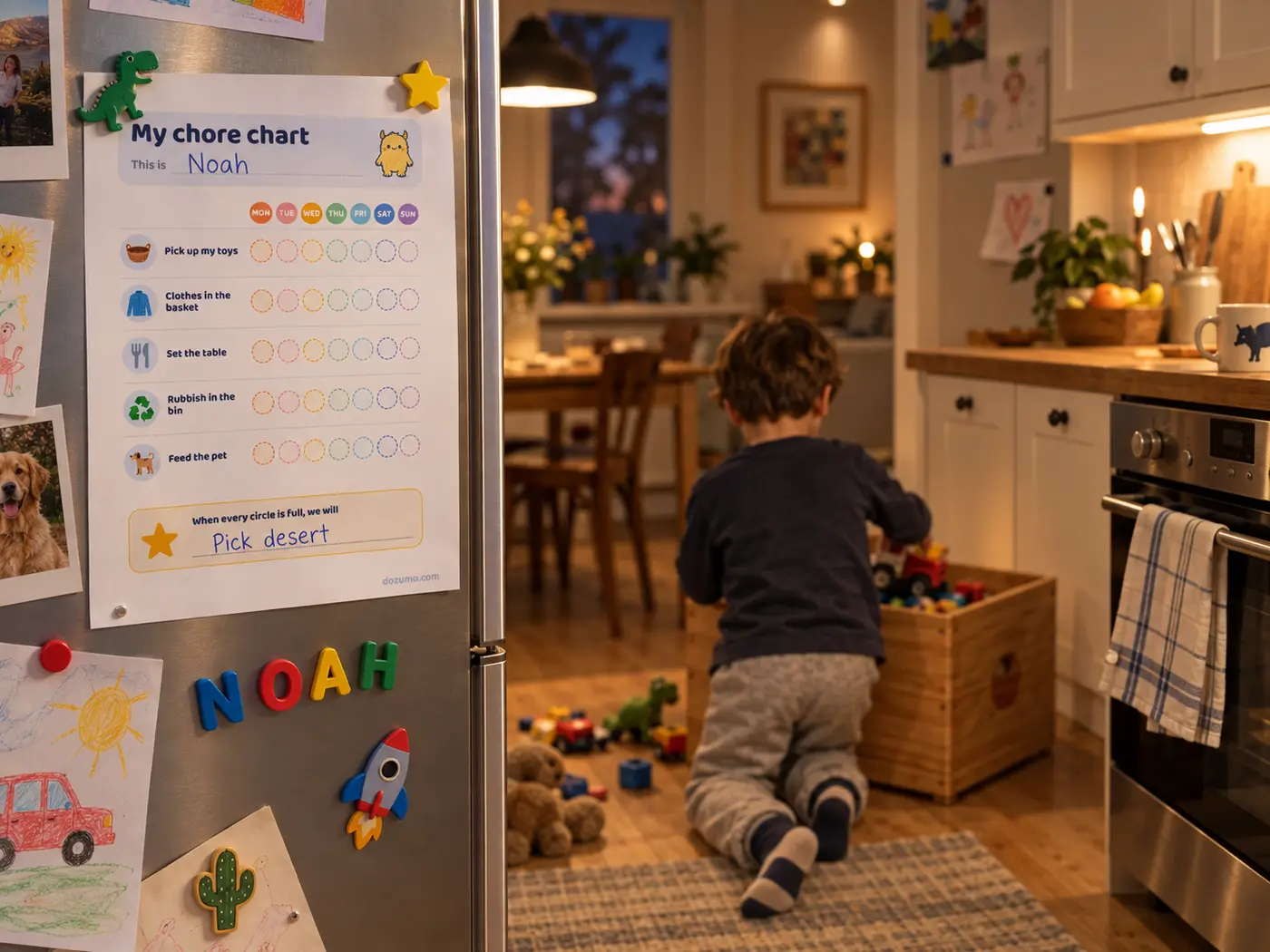
My chore chart
This is

 Pick up my toys
 Clothes in the basket
 Set the table
 Rubbish in the bin
 Feed the pet
Chore chart maker
Build your own instead. This chore chart generator lets you pick the jobs from the list or write your own, change the pictures and who is on it, then print it. Everything unlocked, no sign-up.
How to use it
Print it, write your child's name at the top, and put it where the jobs actually happen rather than in a bedroom. The kitchen is usually right. Mark each job off as it's done, and let your child do the marking: the pen is a surprising amount of the motivation at this age.
The five jobs here are ones a three to eight year old can genuinely finish on their own, which is the only rule that matters. A chore a child can't finish without you standing over them isn't a chore yet, it's a lesson, and putting it on a chart turns every day into a negotiation about whether it counts.
Which chores, at which age
Roughly, and every child arrives at these at their own speed. At three: putting toys in a box, clothes in the basket, rubbish in the bin, carrying their own plate to the sink. At four or five: setting the table, matching socks, feeding a pet, making a bed with help, watering plants. At six or seven: clearing the table, sorting recycling, tidying their own room, folding laundry. From eight: taking the bins out, loading the dishwasher, making their own breakfast.
The pattern underneath that is more useful than the list. A job becomes a chore when a child can do the whole of it, see that it's finished, and be wrong about it without anything breaking. Setting a table has all three. Cooking dinner has none of them until much later.
Cross out anything on this sheet that isn't your house and write your own in the gap. A chart with somebody else's chores on it gets ignored by Wednesday.
Should children be paid for chores?
It's the argument every family has, and both sides of it are reasonable. The case against is that chores are what living in a house costs, and paying for them teaches a child that helping is a transaction. The case for is that pocket money has to come from somewhere, and attaching it to work is a cleaner lesson than money appearing on a Saturday.
The split most families land on is a division rather than a compromise: some jobs are simply expected and unpaid, because you live here, and a separate list of bigger jobs can be paid. That keeps the chart honest. It also stops a child asking what they get before agreeing to carry their own plate.
Under about seven this is mostly theoretical. A sticker and being noticed out loud beat money they can't yet spend on anything they want.
When it stops working
Two or three weeks, as with every paper chart, because nothing about it changes. Change the reward before you change the chart, and take a job off before you add one. Four chores that get done beats five that get argued about.
If a particular job is where every week falls apart, it's usually the job rather than the child: either it's too big to finish, or too vague to know when it's done. “Tidy your room” is the classic of both. “Toys in the box” is the same job with an end to it.
Or let Dozumo do it
Dozumo runs the same jobs on a phone, with a creature working through them alongside your child. The one on this chart is Mozumo. It reacts as each is done and celebrates the last one, so what's pulling them along isn't you asking again.
It also grows with them, which is the thing a printed sheet can't do. A three-year-old putting toys in a box and a nine-year-old loading the dishwasher are the same ladder. The app moves up it as they do, rather than needing a new chart printed.
Finishing a job earns Zumos, which your child spends on rewards you set. A film night while they are small, pocket money once they are older, which is one way to settle the paid-or-unpaid argument without having it. Join the waitlist and we'll tell you when it opens.
Common questions
What chores can a 3 year old do?
Putting toys in a box, dirty clothes in the basket, rubbish in the bin, carrying their own plate to the sink, and putting shoes on a rack. All of them share the same shape: one step, a visible end, and nothing that breaks if it goes wrong. Expect help to be needed for months before it is not.
At what age should children start chores?
Around three, and earlier than most families expect. The point at that age is not the work getting done, which it largely will not, but that helping is simply what happens here. A three-year-old who has always carried their plate to the sink is not being asked to start doing chores at eight, which is a much harder conversation.
How many chores should a child have?
Three to five at a time under about eight. The number matters less than whether each one can be finished: a child with three jobs they complete is building a habit, and a child with seven they half-do is learning that the chart is decoration. Take one off before you add one.
Should children be paid for chores?
Most families end up splitting it: some jobs are expected and unpaid because you live here, and a separate list of bigger ones can be paid. That keeps the everyday chart out of the negotiation. Under about seven it barely matters, because being noticed out loud beats money a child cannot yet spend.
What should be on a chore chart?
Jobs your child can finish alone, named so that both of you can tell when they are done. “Toys in the box” rather than “tidy your room”. Leave off anything that needs you standing there, and leave off anything that happens without an argument, because a chart is for the hard part rather than a record of the week.