
Free printable
Antecedent behavior consequence chart: a free printable ABC chart
A free printable ABC chart for parents asked to record behaviour at home, and how to read what you write down. No sign-up and no email.
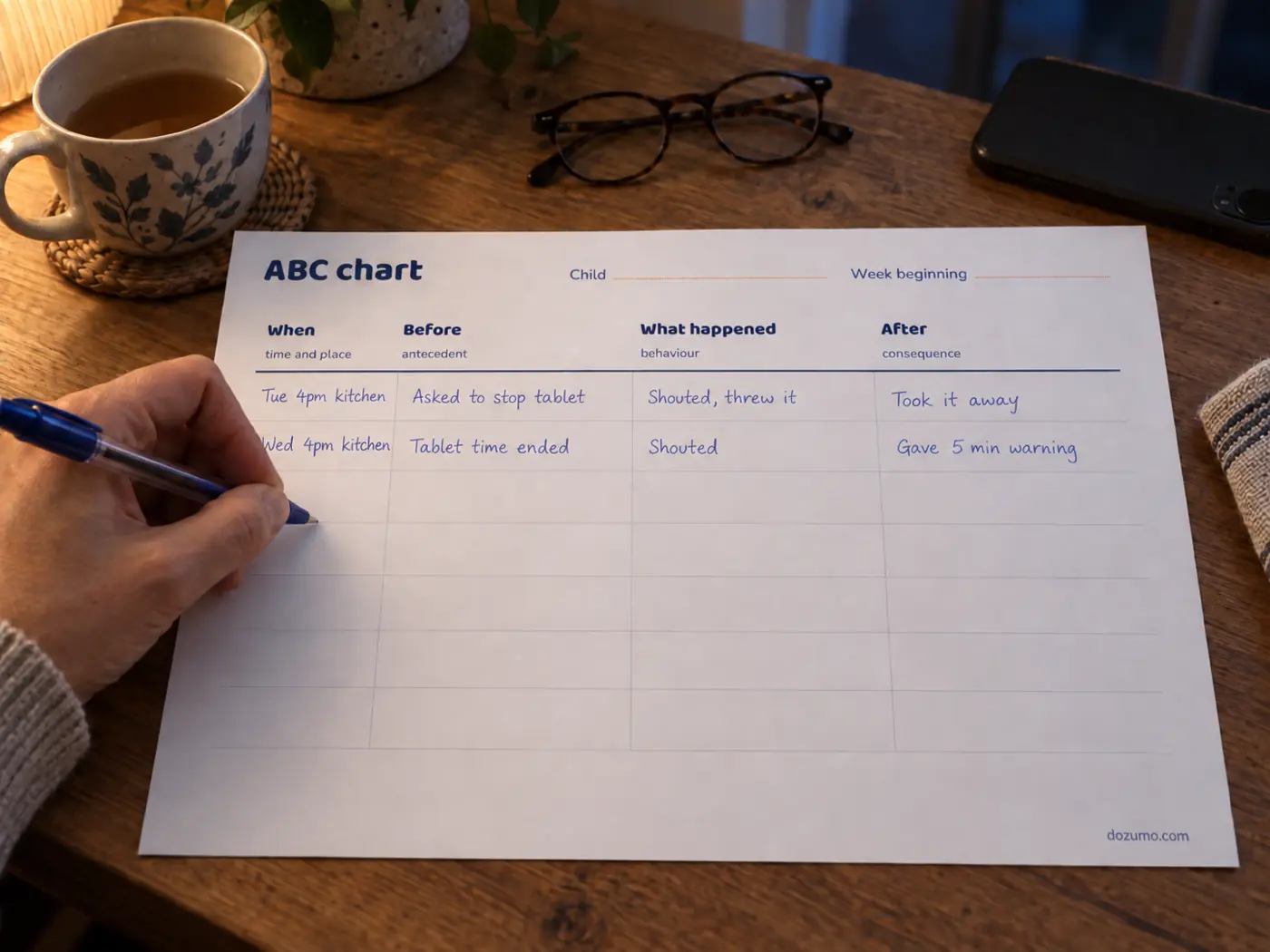
ABC chart
Child
Week beginning
Fill it in as soon after as you can. What you are looking for is the pattern down Before and After, not down What happened.
dozumo.comWhat the three letters mean
Antecedent, behaviour, consequence. Or: what was happening just before, what your child actually did, and what happened next. The words are the reason this feels harder than it is, so the sheet above puts the plain question on top and keeps the clinical word underneath it.
Before is the one people get wrong. It does not mean the cause, and you are not being asked to work out why. Write down what was going on in the room: who was there, what had just been asked, what was about to end. “Told it was time to leave the park” is a good antecedent. “He was tired and frustrated” is a guess, and guesses are the thing this form exists to replace.
After means what the people around your child did, not whether it worked. If you gave in, write that you gave in. If three adults came over, write that three adults came over. This column is the one that most often turns out to be doing something nobody intended.
How to fill it in
As soon after as you can manage, and in your own words. Nobody is marking this. A line written badly at four o'clock beats a careful paragraph reconstructed at bedtime, because by bedtime you will have started explaining rather than recording.
Write what a camera would have seen. “Threw the cup, shouted, ran upstairs” is data. “Was being defiant” is a conclusion, and a fortnight of conclusions tells the person reading it nothing they did not already assume.
One incident per row. Two weeks is the usual ask, and seven rows is a page: print two if a fortnight is busier than that. Do not try to catch everything. Six honest entries are worth more than twenty rushed ones.
Reading it back, which is the part nobody tells you
This is what the form is for, and almost every version of it you will find hands you the grid and stops. After a week or two, put the sheet on a table and read down the columns rather than across the rows.
Down Beforeyou are looking for a repeat. If four of six entries say some version of “asked to stop doing something they were enjoying”, you have found a trigger, and transitions are the thing to work on rather than the behaviour itself.
Down After you are looking for what your child reliably got. Attention from an adult, escape from something they did not want to do, or the thing they were asking for. That is not a judgement about your parenting; it is how behaviour works in every house, and it is the single most useful sentence you can hand a teacher or a paediatrician.
What happened is the column everybody stares at, and it is the least useful of the four. What your child did is the part you already know.
When is worth reading too, and it is easy to dismiss as admin. A column that says four in the afternoon and kitchen over and over is pointing at the end of the school day, or at hunger, and neither of those will ever appear in the Before column because nobody writes down that a child was tired.
If a school or a clinician asked you for this
Then they are going to read it, and it is worth asking them two things before you start: how long they want, and whether they want every incident or only a specific one. Those two answers change what you write down, and being told after a fortnight that you recorded the wrong thing is a miserable way to spend a fortnight.
What you are producing is one input into a functional assessment, not the assessment. The person who asked for it is trained to read it and to decide what follows, and this page is about filling the form in well rather than about what to do with what it says. If nobody has asked and you are doing this on your own, it still works: you are simply the person reading it too.
Where Dozumo fits, and where it does not
It does not do this. Dozumo is a routine app for children at home, it has no incident log and no behaviour data in it, and building one is not on the list. A form like this belongs with the people who are trained to act on it.
Where it does overlap is what usually comes next. ABC data very often points at the same handful of moments: leaving the house, ending screen time, getting into bed, being asked to stop and start something. Those are transitions, and a visual schedule is the standard first answer to them, because a child who can see the change coming is not being ambushed by it.
That is the part Dozumo is for. Join the waitlist if it sounds useful, and ignore it if it does not; this sheet is free either way and there is no email box on this page.
Common questions
What is an ABC chart?
A form for recording what happened around a difficult moment: the antecedent, meaning what was going on just before, the behaviour itself, and the consequence, meaning what happened next. It is used to find patterns across a week or two rather than to judge a single incident, and it is usually the first step of a functional behaviour assessment.
What counts as an antecedent?
Whatever was observably happening in the minute or so before: who was in the room, what had just been asked, what was ending, what had been refused. It is not the cause and it is not your theory about the cause. “Asked to turn the tablet off” is an antecedent. “Overtired” is a guess, and guesses are what the form is there to replace.
How long should you keep an ABC chart for?
Usually one to two weeks, and if somebody asked you for it, ask them. A fortnight is long enough for a repeat to show up and short enough that you will actually keep doing it. Six or eight honest entries across two weeks are more useful than a rushed entry every day.
What do you do with an ABC chart once you have filled it in?
Read down the columns rather than across the rows. Before tells you what tends to come first, which is usually a transition or a demand. After tells you what your child reliably got, which is usually attention, escape, or the thing they were asking for. Those two answers are what a teacher or clinician wants from you, and they are more useful than What happened, which is the part you already knew.
Is an ABC chart only for autistic children?
No. It is most associated with autism and with ABA because that is where the method was formalised, but it is a general tool for working out what is driving a behaviour, and it is used in mainstream classrooms, in paediatrics and by plenty of parents with no diagnosis in the house at all.