
Free tool
Free printable token board template
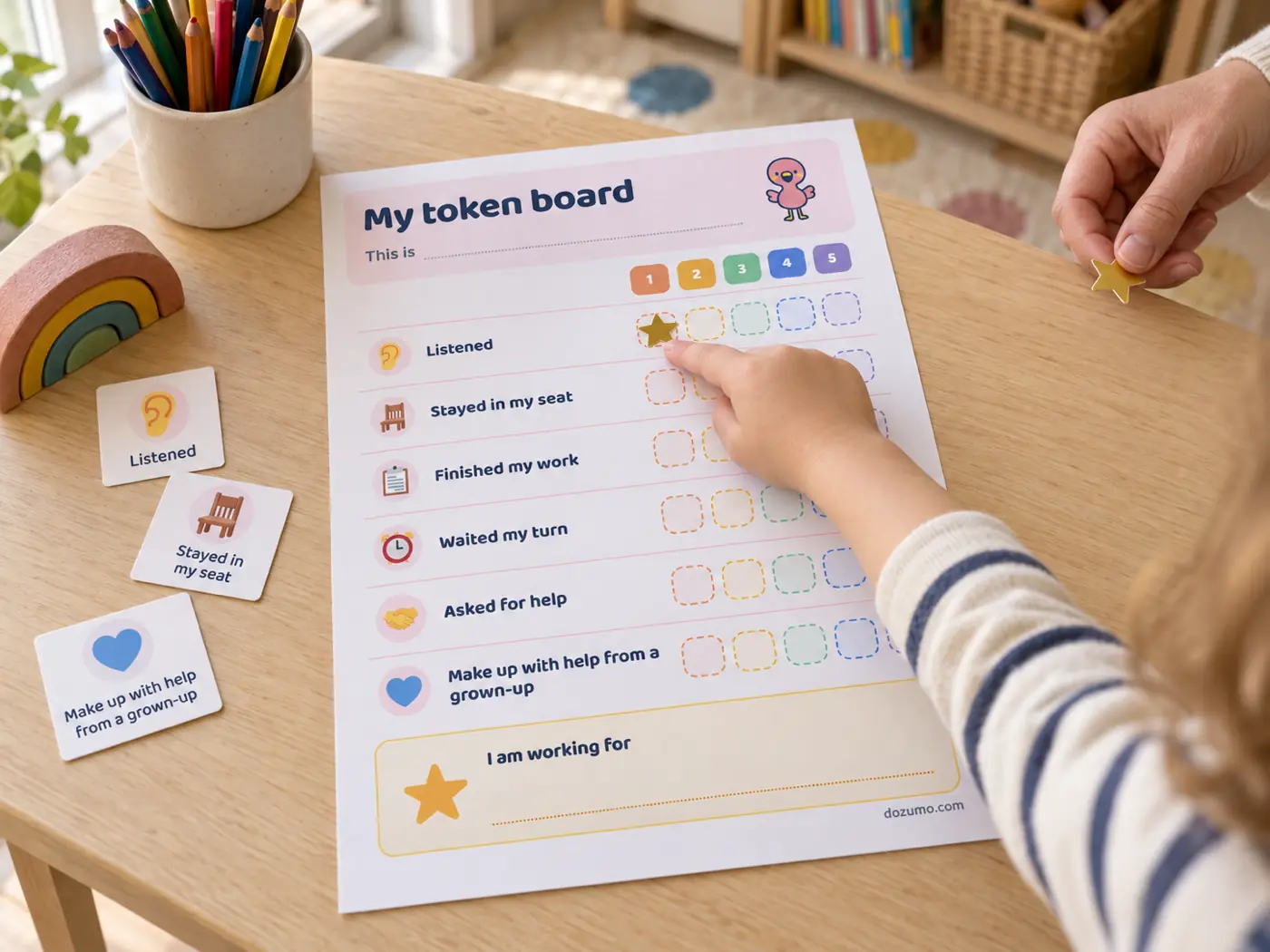
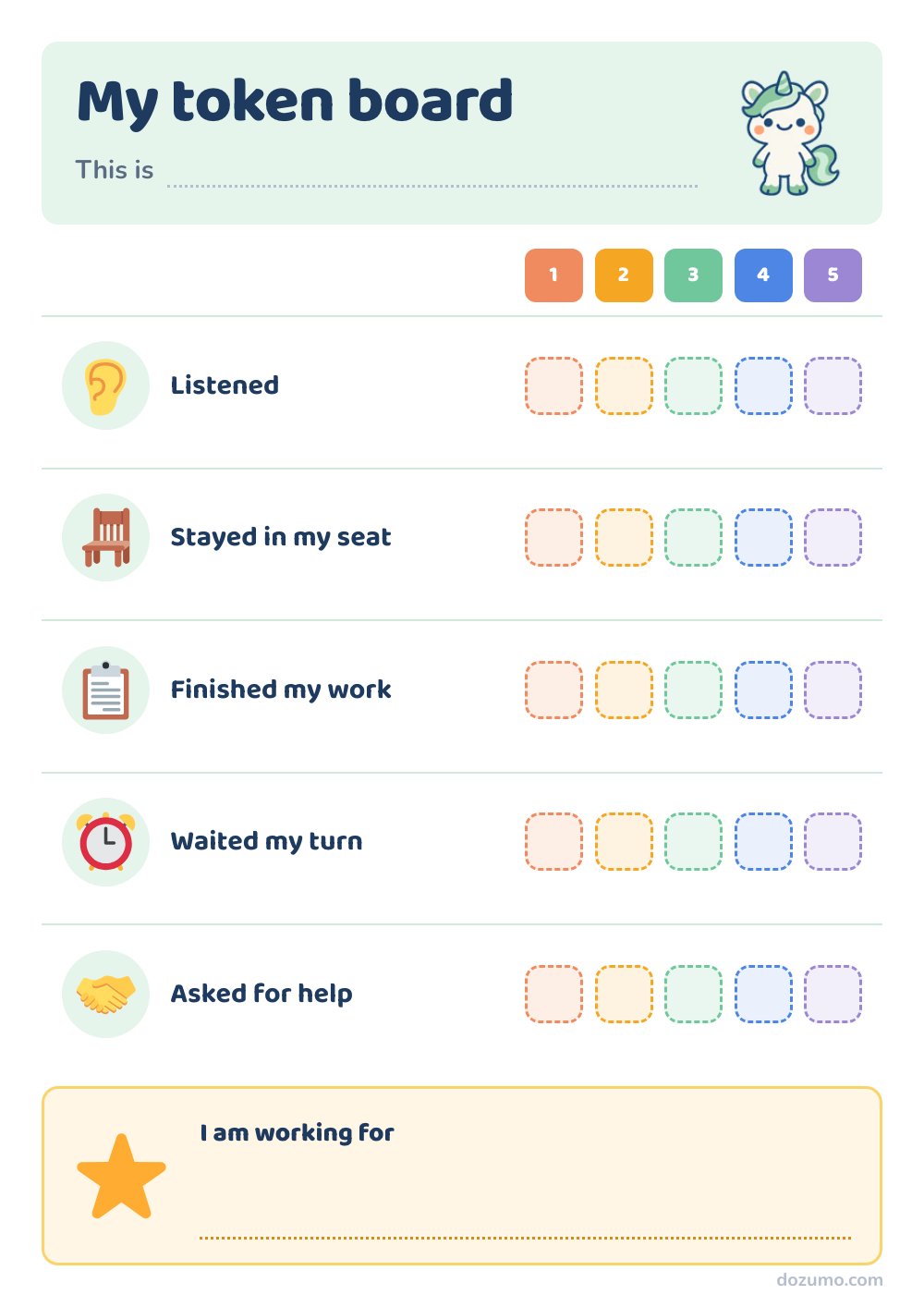
A token board makes an abstract deal visible: earn five tokens, then the thing you agreed. Build your template below, print it, and hand over a token each time the behaviour happens. Set the target, the number of tokens and the picture on every row, or change nothing and print it as it comes.
- Editable template, free to print
- Build it here, no software
- No sign-up or email
Build it
The board
Tokens
Start with what your child can actually reach. Three is often right for a new target, and ten is usually too far away to pull anybody.
What goes on it
How it looks
My token board
This is

 Listened
 Stayed in my seat
 Finished my work
 Waited my turn
 Asked for help
Free, and there is no email box on this page. What you build stays in this browser.
How to use it
Write what the child is working for along the bottom before you start, and agree it with them rather than announcing it. Then hand over a token each time the target behaviour happens, say what it was for as you do it, and stop. Five tokens, then the thing at the bottom, immediately.
Immediately is the part that gets lost. A token board is not a record kept during the day and cashed in later; the delay between the behaviour and the token is the variable that decides whether any of this teaches anything. If you are marking it at the end of a session you have built a chart, which is a different and slower tool.
One row, or five
A classic token board is one behaviour and five tokens. The board above starts with five rows because a page with one row on it is a waste of paper, not because five targets at once is a good idea. Delete the four you don't need, or keep them and cut the printed sheet into strips.
Five rows earns its place in one situation, which is a child working across a morning with several adults: a row each for the things different people are reinforcing, so nobody has to remember what the others agreed. If that isn't your situation, one row is the better board.
The targets printed here all name something to do rather than something to stop, which is the same rule that applies to any target you write in yourself. There's nothing on this sheet a child can fail, and no token comes back off once it's given. Response cost is a different technique and this is deliberately not a sheet for it.
What the tokens buy
Something small, soon, and genuinely wanted by this child rather than by children in general. Two minutes on a swing, a turn with the thing they keep looking at, choosing the next activity. The size of the reward matters much less than how quickly it arrives and how reliably it does.
If a child isn't working for it, the board isn't broken and neither are they. Either the reinforcer is wrong or the target is too hard for five repetitions. Change one of those, not both at once.
Fading it
The board is scaffolding, and it's supposed to come down. The usual path is to thin the schedule rather than to stop: a token for every second instance, then every third, then for a stretch of time rather than a count, then a board that stays in a drawer for the hard days. A board that is still doing exactly the same job six months in is a board nobody has planned an exit from. Worth noticing early.
What this is not
A printable is a sheet of paper, not a programme. If you are running a token economy as part of a behaviour plan, the target, the schedule and the fading criteria come from the person writing that plan, and this is simply a board with your palette on it instead of theirs. Everything above is the ordinary practice around the format, not advice about a particular child.
Or let Dozumo do it
Dozumo is a routine app for children at home, and the mechanism underneath it is this one: a small immediate thing earned for a specific behaviour, traded later for something the child chose. It's a token economy with a creature on top of it.
The difference paper cannot close is the delay. The app gives the token at the moment the thing happens, every time, without an adult having to be in the room with a jar of counters. Nothing is ever taken away, and there's no record of a bad day to look back at.
It's built for families rather than classrooms, so the home half is what it covers. Join the waitlist and we'll tell you when it opens.
Or print one as it comes
The same board with each of the four creatures on it, already made. Pick one if you would rather not build anything.
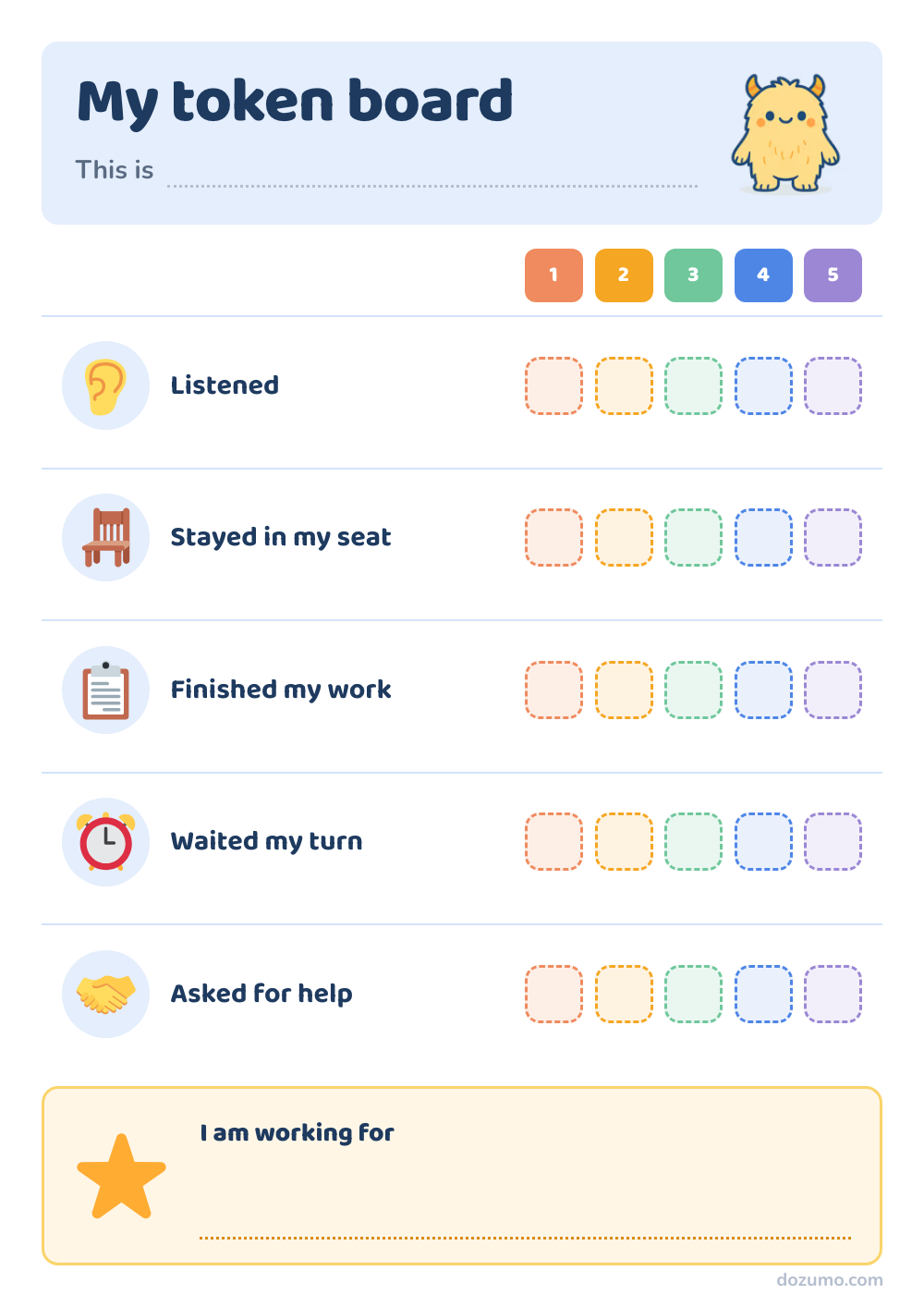 Mozumo
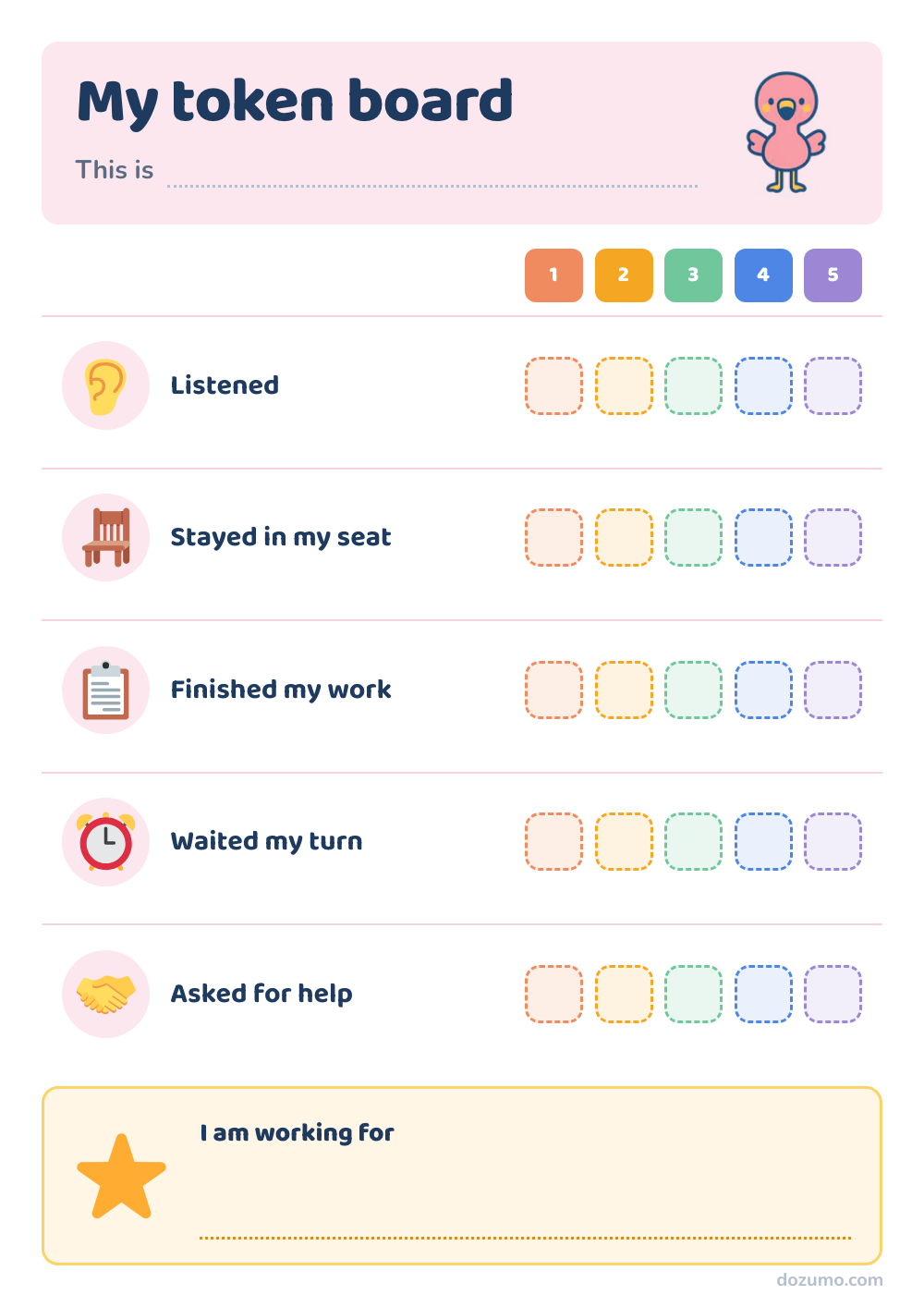 Flazumo
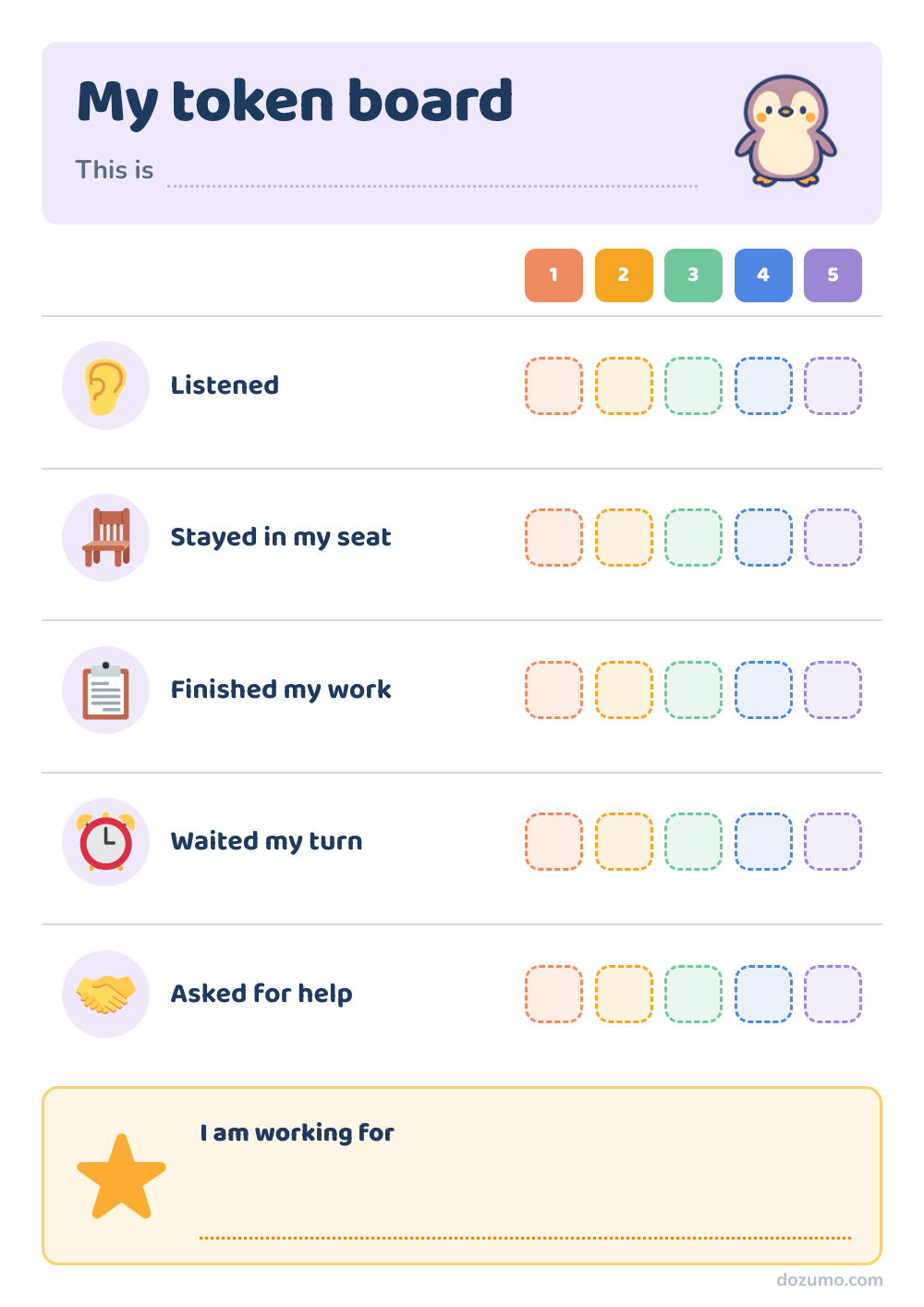 Pezumo
 Unizumo
Common questions
What is a token board?
A strip of spaces a child fills with tokens, one at a time, for a specific behaviour. When the strip is full they trade it for something agreed in advance and written at the bottom. It makes an abstract deal visible: a child who cannot hold “if you keep doing this you will get that” can see exactly how much further there is to go.
How many tokens should a token board have?
Start with the number the child can actually reach, which for a young child or a new target is often three rather than five. Five is the usual default because the end stays visible from the start. Ten is where boards go wrong: the last few tokens are too far away to pull anybody, and the board stops meaning anything by token four.
What is the difference between a token board and a token economy?
The board is the object; the economy is the system around it. A token economy sets out what earns a token, what the tokens buy, at what rate, and how the whole thing is thinned out over time. The board is just where the tokens go while that is happening. People use the words interchangeably, which is fine until you need to change something and cannot say which part is not working.
How do you fade a token board?
Thin the schedule rather than stopping. A token for every second instance, then every third, then for a period of time rather than a count, then the board only on hard days. Do it gradually enough that the behaviour does not fall over, and expect to go back a step when something changes. The board is scaffolding and it is meant to come down.
Do token boards only work for autistic children?
No. They are most associated with autism and ABA because that is where the format was formalised and where the evidence base sits, but the mechanism is ordinary and works with any child who can see a goal and count towards it. Plenty of mainstream classrooms and plenty of kitchens run one without calling it that.